
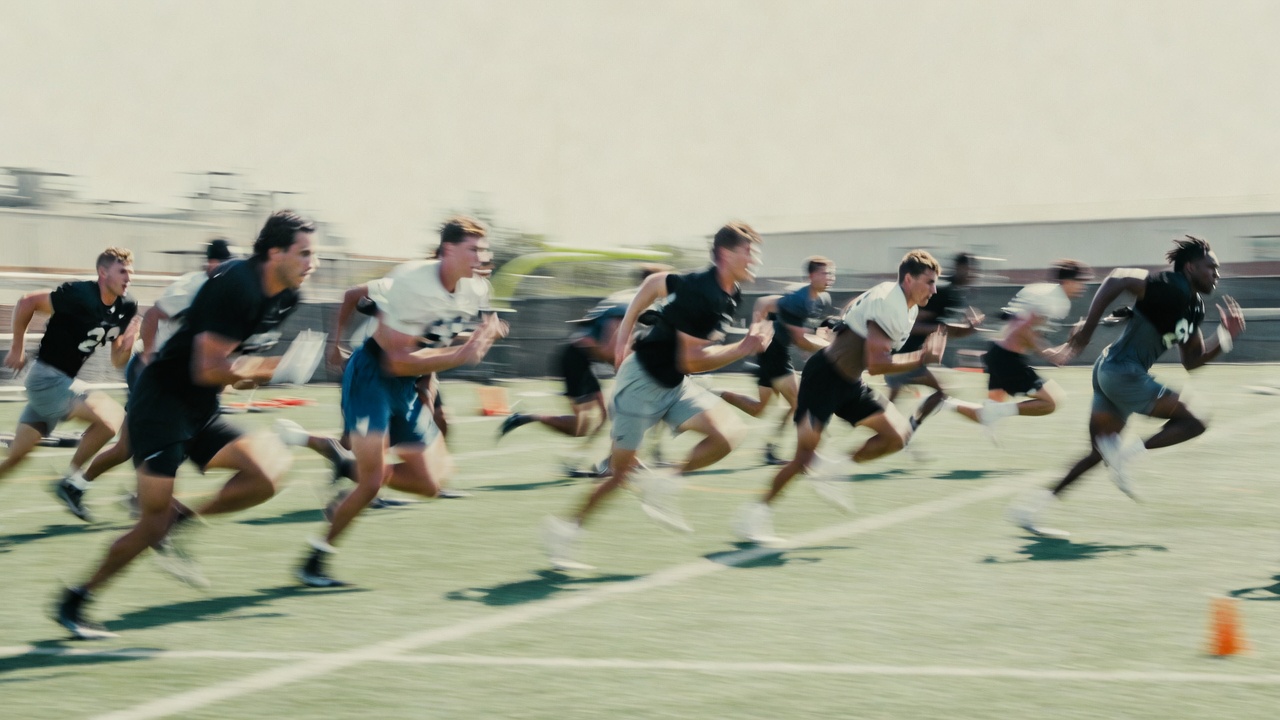
Chris Doukakis oversees strength and conditioning for 400+ student athletes. Demotu gave him the joint-level data to confirm his programming is working — and a shared language with his athletic training staff to act on it.
Managing S&C across an entire high school athletic program is a different job than managing a single team. Multiple sports. Overlapping offseasons. Each with its own movement demands, its own injury risks, its own programming requirements — and a roster that keeps growing every season.
When Chris Doukakis took over strength and conditioning at Chaminade College Prep, the immediate priority wasn't just building a program — it was building one with the infrastructure to actually see what was working.
I wanted a more accurate, efficient process for assessing my athletes. I currently work with 400+ student athletes and that number keeps rising.
Eleven months in, the data is already telling the story.
What Changes When You Can Measure Every Joint
Demotu uses advanced computer vision to capture movement assessments directly from a phone camera — no sensors, no wearables, no lab equipment. A short video recording becomes a full biomechanical analysis, evaluating how each joint moves across six foundational movement patterns — squat, hinge, lunge, push, balance, and jump — while tracking sixteen individual joint movements to identify mobility limitations, asymmetries, and compensation patterns. Borelli AI then translates that data into actionable coaching insights and training recommendations in minutes.
At scale, that changes two things.
First, it validates the work. When you're measuring the same joints the same way at the start and end of every cycle, you don't have to wonder if your programming is translating. The retest answers that.
Second, it creates a longitudinal record that passive observation never could. Compensation patterns — the way a body quietly offloads one joint to protect another — rarely announce themselves until they've already become an injury. Tracking movement data across cycles means you're seeing those patterns accumulate in real time, not discovering them on the training table.
Baseball Team — 7-Week Offseason Cycle
After one 7-week offseason training cycle, the baseball program improved across nearly every tracked movement category — hip, knee, and ankle mobility, with measurable gains in overall functional output.
One category remained in the red. That's not a failure — that's the map for next cycle. Objective data doesn't just tell you what's working. It tells you exactly where to go next.
Defensive Lineman — Football
Single Offseason Cycle
| Metric | Pre | Post | Change | ROM Change |
|---|---|---|---|---|
| Overall Functional Score | 43 | 75 | +74% | — |
| Right Hip Mobility | 73 | 87 | +19% | 88° → 104° |
| Left Hip Mobility | 92 | 90 | Maintained | 110° → 108° |
| Right Knee Mobility | 78 | 93 | +19% | 102° → 121° |
| Left Knee Mobility | 75 | 76 | Maintained | 98° → 98° |
| Right Ankle Mobility | 74 | 88 | +19% | 22° → 26° |
| Left Ankle Mobility | 48 | 65 | +35% | 15° → 19° |
Overall score up 74% in one offseason. But for this lineman, the left ankle is the number that mattered most.
At 48 entering the offseason, it was the weakest link in his chain. A restricted ankle doesn't just limit mobility — it redistributes load. The knee picks up what the ankle can't handle. The hip compensates for the knee. Across a full season of contact, blocking reps, and explosive first steps, that pattern is how athletes end up hurt in joints that had nothing to do with the original restriction.
That ankle is at 65 in January. ROM went from 15° to 19°. His right knee ROM expanded from 102° to 121°. The programming targeted the right things. The retest confirmed it.
Left hip held at 90 — one of the few metrics that didn't need to move. That's not a gap in the data. That's a precise program doing exactly what it should.
Senior Pitcher — Baseball
Two Offseason Cycles
| Metric | Pre | Post | Change | ROM Change |
|---|---|---|---|---|
| Overall Functional Score | 44 | 85 | +93% | — |
| Right Hip Mobility | 49 | 67 | +37% | 59° → 80° |
| Left Hip Mobility | 54 | 70 | +30% | 64° → 84° |
| Right Knee Mobility | 60 | 71 | +18% | 77° → 93° |
| Left Knee Mobility | 50 | 70 | +40% | 65° → 91° |
| Right Ankle Mobility | 61 | 100 | +64% | 18° → 36° |
| Left Ankle Mobility | 50 | 68 | +36% | 15° → 20° |
Every joint. Both sides. All of them better.
Overall score from 44 to 85 across two cycles. Right ankle at 100 — a perfect score — with ROM doubling from 18° to 36°. Left knee up 40%. Both hips up 30–37%.
For a pitcher the kinetic chain is the whole story. Ankle loads. Knee drives. Hip rotates. The arm follows. When any link is restricted the body finds a way around it, and that workaround travels upward. Over hundreds of throws across a full season, that's how arm problems develop in athletes whose arms were never the actual problem.
Two cycles of targeted programming addressed every link in that chain. The data at every joint confirms it resolved. For a senior pitcher heading into his final high school season that's not just a performance outcome — it's his arm health.
The Data Doesn't Stay in the Weight Room
“If you want an efficient and accurate way to pinpoint gaps in your programming, use Demotu. It provides the precise insights I need to tailor training for each team's specific movement needs both in the weightroom and competition. I also present my data to the Athletic Training staff and together we come up with a gameplan moving forward.”Chris Doukakis · Director of Strength & Conditioning, Chaminade College Prep
Chris shares his movement data directly with the athletic training staff — same measurements, same baselines, one unified picture of each athlete built and acted on together. S&C and athletic training working from the same information means the gap between performance and injury prevention isn't managed reactively. It's closed before the season starts.
Eleven Months. This Is What the Data Shows.
A lineman's functional score up 74% in a single cycle. A pitcher's nearly doubled across two. Every bilateral movement metric trending in the right direction. Compensation patterns identified and addressed before a single game was played.
Demotu gives me a quicker and more accurate map of each team's deficiencies. It's allowed me to focus on more effective programming.
At 400+ athletes, that clarity isn't a feature. It's the difference between a program that reacts and one that stays ahead.
Join the programs using Demotu to track performance, prevent injury, and make every training cycle count.