
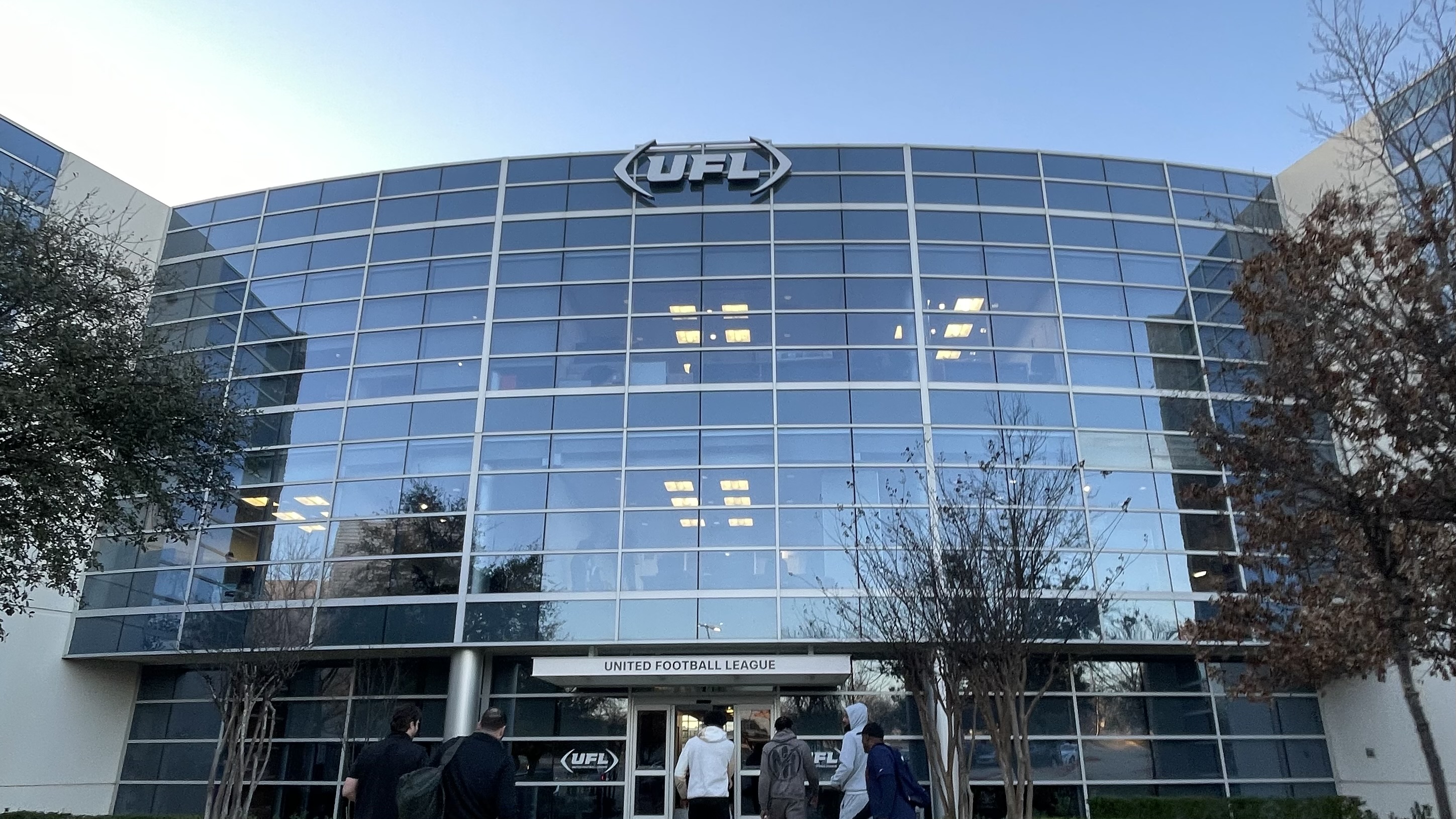
Last weekend, our team traveled to Arlington, Texas for the opening weekend of UFL pre-season training. The event brought together hundreds of elite athletes, coaches, and performance staff — and gave us the opportunity to put Demotu’s movement assessment technology to work in one of the most demanding environments in professional sports.
In under seven hours, we assessed 512 athletes across four movement patterns: overhead squat, overhead press, single-leg RDL, and countermovement jump. At no point did we have more than three athletes being assessed at once.
The energy inside the facility was immediate. Athletes moved through the stations with curiosity, eager to see their movement data in real time. For many, it was the first time they had received objective insights into their mobility, stability, and movement imbalances — without the delay of manual data entry or subjective analysis. As Demotu processed each movement in seconds, performance staff watched reports generate automatically, highlighting limitations, asymmetries, and inefficiencies they could take directly into their programming for the season ahead.
In under seven hours, we assessed 512 athletes across four movement patterns. At no point did we have more than three athletes being assessed at once.
High-volume screening is no longer a bottleneck
This wasn’t just about running movement screens. It was about proving that large-scale assessments can be fast, reliable, and integrated into elite training environments without disrupting them.
Traditional movement evaluations require manual observation, subjective scoring, and delayed reporting. When working with professional athletes, every minute of training time counts — stopping to conduct in-depth screenings is often impractical. Demotu eliminated that barrier. Real-time, automated reports delivered directly from a mobile device meant coaches had actionable data the same day, influencing programming decisions from adjusting mobility work to refining strength and conditioning protocols before the season began.
For athletes, the immediate feedback turned what could have been a routine test into something genuinely useful. Many left understanding their movement in a way they hadn’t before — and with a clear picture of where targeted work could lead to real performance gains.
Real-time, automated reports delivered directly from a mobile device meant coaches had actionable data the same day, influencing programming decisions before the season began.
Two seasons. 500+ athletes screened.
“I have utilized Demotu over the past two seasons as an integral part of our athlete evaluation and performance process. During that time, we incorporated the technology into our entrance physicals, screening more than 500 athletes to efficiently identify movement limitations and potential risk factors. Throughout the season, Demotu has also been a valuable tool for reassessing movement patterns, guiding corrective exercise strategies, and informing elements of our return-to-play decision-making. The platform provides objective, actionable data that enhances both performance and medical decision-making, and the vision behind Demotu is clearly reflected in the practicality and effectiveness of the system.”— Dr. Steve Trocchio, PT, DPT · Director of Player Rehabilitation, UFL
Four patterns. One profile.
The four movement patterns assessed each provided distinct insight into an athlete’s mobility, stability, and power output — building a comprehensive movement profile for every player on the roster.
Overhead Squat
Revealed mobility restrictions in the ankles, hips, and thoracic spine, helping coaches identify limitations that could reduce movement efficiency in sport-specific scenarios. Compensatory patterns — excessive forward lean, knee valgus, limited depth — flagged potential injury risks and force production inefficiencies. We also observed a consistent 10-degree variance in ankle dorsiflexion between left and right in athletes with no prior injury history, a common but frequently missed asymmetry tied to foot dominance.
Overhead Press
Highlighted shoulder stability and thoracic mobility — critical for athletes in positions requiring upper-body strength and control. Limited scapular movement and bilateral imbalances gave coaches direct insight into restrictions that could affect lifting performance, throwing mechanics, and long-term durability.
Single-Leg RDL
Assessed balance, stability, and posterior chain engagement, making it the most effective screen for unilateral weaknesses. Athletes who demonstrated instability or knee valgus under single-leg load were flagged for movement inefficiencies that could impact change-of-direction mechanics and soft tissue injury risk.
Countermovement Jump
Measured lower-body power output and landing mechanics — giving coaches a direct read on each athlete’s neuromuscular efficiency and readiness for high-intensity training. Instead of waiting days for analysis, coaches had this data immediately, allowing them to make informed adjustments to early-season conditioning on the spot.
Assessing 512 professional athletes in a single day proved that high-volume, high-accuracy movement screening is no longer a bottleneck for performance programs. It's an asset.
From idea to reality
The feedback from coaches, trainers, and athletes was clear — the speed was unexpected, the data was deep, and the insights were immediately applicable. Strength coaches left with movement profiles that shaped their first week of programming. Athletes left with a better understanding of their mechanics and how small changes in mobility or stability can lead to meaningful performance gains.
Scaling movement screenings without sacrificing accuracy or speed is no longer an idea. It’s a reality. And this partnership with the UFL is only the beginning — as we continue building toward individualized performance optimization for every athlete on the roster.
Book a walkthrough with our team and we’ll show you how Demotu fits into your existing workflow.